Showing posts with label Opaque. Show all posts

Friday, September 25, 2015

Knight of the Card Table: Battle for Zendikar Prerelease Primer

Knight of the Card Table: Battle for Zendikar Prerelease Primer


Welcome to my new semi-regular article series I'm calling Knight of the Card Table, covering all things tabletop, card and board games alike! I'm starting off heavy duty with the first in a three part series, all revolving around the release of the first Magic: the Gathering set coming out in the new standard rotation. Battle for Zendikar is set to release in one week; which means tonight is officially the last FNM of the old standard, and that means it's Prerelease Weekend! Let's get started...

Tourism is the prime resource of Zendikar,
just look at these happy visitors!

There's been a veritable hurricane of information surrounding this return to Zendikar ever since its announcement back on March 9, but there's some parts that are more important heading into this weekend's festivities. Sure enough, Wizards has written their own primer, and even treated the fine folks of Ars Technica to a private prerelease earlier this week. As if the change to the standard rotation - which I mentioned last in my Magic Origins article in July - weren't enough, the format of the prerelease is changing as well, if only slightly. Until now the prerelease packs have consisted of five booster packs, one of five dated promo cards and seeded card pack tied to the theme or color grouping of a rather unusable box, along with a spindown counter and literature, or some similar iteration to this load out. The prerelease packs this time around are nixing that seeded pack altogether in favor of a sixth booster pack; there's still a foil promo card, but instead of one of five, it could be any rare or mythic rare from Battle for Zendikar; the spindown stays and the literature's been simplified a bit; and it all comes packed in a reusable deck box! (The last time they did the closest to this, was for the Dragon's Maze prerelease.)

With a box like this, opening one may feel like opening a hedron itself...

Next up, we need to talk briefly on some new and returning mechanics. Stepping up to bat we have Awaken, Converge, and Ingest. And back for another swing are favored abilities like Rally, an ability trigger with its roots in Zendikar's Ally creature class; and Landfall which returns unfettered straight from the first Zendikar block. Both of these returning abilities will require keen eyes for when cards enter or act on the field. Finally, be sure to keep a watchful eye out for Devoid cards, they'll make big plays for being colorless inspire of their casting costs. For more help, I highly recommend Wizards own prerelease primer, their article on the sealed deck format, and this article on the mechanics in Battle for Zendikar.

Last on the slab is of course something everyone's been waiting for since the last time we visited Zendikar, full art basic lands. This will be the first chance everyone will be able to get their hands on some brand new, fresh printed full art lands that haven't been sitting in someone's drawer for the last 6 to 16 years, planswalkers rejoice! So if you've been envious of an opponent's deck full of Zendikar land and unwilling to shell out almost $1.50+ per card, know that we are literally t-minus one week and counting until that playing field is leveled and full art basics are affordable agin. As an added bonus...sort of, WotC has decided to up the ante to another level by adding in an extra chase factor to the BFZ release: the 25 Zendikar Expeditions cards. These full art, foiled, chase versions of the shock and pain lands are being inserted into booster packs at a ratio of nearly 1 card per case of boosters packs. Now, boosters are sold in 36 pack boxes, which then ship to stores in cases of 6 booster boxes. Wizards has said that these cards will be slightly less rare than pulling a premium foil mythic rare, so this places the ratio of these cards at just less than 1:3240 cards or 1:216 boosters. This was definitely a boost in preorder sales for M:tG, indeed my LGS is nearly sold out. It could be possible to see some of these make their debut this weekend as well.

Take a peak at the beautiful chase bounty...
For some, it may be as close as they get...

But have no fear readers! I have a release article planned, complete with product as I have per the Core releases. Until then, have a look-see at Magic's Battle for Zendikar Card Image Gallery, and be sure to head back on Tuesday for my Prerelease Recap and Setup for Release Day! Good luck this weekend everyone; shuffle well, and tap strong! For Zendikar!

Saturday, July 18, 2015

Magic: the Gathering Magic Origins Release Day


Greetings to all my fellow gamers out there! Yes, I've been away for some time (again) and it's long-overdue for my triumphant return from convalescence. So without even further delay, here's my brief coverage of Magic: the Gathering Magic Origins Release Day!

I've been playing for almost 20 years and all I've got is this final Core Set.

I hope everyone had a great PreRelease last weekend and enjoyed their LGS' festivities and getting their hands-on preview before getting to today's actual release. For those of you lucky to have played at Friday Night Magic last night I hope that went just as well, along with the use of the newest addition the multiverse. With all of the cards fully leaked in advance of the PreRelease, we now find ourselves (finally!) at today. In review of the product, overall, the cards themselves of this set seem to have a slightly higher quality than the M15 Core Set in my opinion, from the printing quality to the feel of the cards themselves. Maybe I just had somewhat higher hopes for this set in that arena, as I'm sure Wizards hadn't changed much, if at all. And while the graphic styling and representation of this set left me wanting initially, its grown on me. Especially after seeing the packaging of the boosters themselves, and the details within the Fat Pack, the opposing duality of using white and black is pretty smart for the context of what they aimed to achieve. But most people choose to hold their excitement for the first release of the next block, and don't get too worked up over the Core Sets.

I, however, do get excited...

Magic Origins has quite a lot going on around it. Probably the most interesting thing to note regarding this release is the fact that Origins is the absolute last Core Set to ever be printed by Wizards of the Coast. Can they print another one eventually? Sure, but that isn't the case right now, with all fingers pointing to "not going to happen." So as it stands right now there will not be a Core released in 2016, and likely will not ever be one again. Core Sets (formerly base sets, until circa 2003 (Eighth Edition)) have been around since the game's inception in 1993 with Limited Edition Alpha; these sets were released inconsistently, between a few months apart to as much as 26 months apart through Tenth Edition, then annually every July beginning with Magic 2010. All told, this marks the 18th Core Set to be released, when including both the LE Alpha, LE Beta, Unlimited, and Revised sets individually though they were all released over the span of just 10 months between 1993 and 1994. For the last decade, the Core Set's purpose has been to work by and large in conjunction with the block rotating out of standard play. This sounds a bit weird until you consider that the core's themselves include reprinted cards for the majority of the set, with a very few new cards being introduced for the first time; so certain cards from the soon-to-be rotating block become reprinted in the core so that some of the staple cards can remain in standard for a little longer. There's actually a lot of changes happening in and around this last Core Set, probably due to the finality of this release. For anyone that's been hesitant to get into (or back into, for those former players set in their old-school ways) this seems to me to be the perfect time to be jumping back in, so I'll touch just on a couple of the important ones.

Don't let this confuse you too much,
Donald Duck's nephews eventually got much better names.

First and foremost is that we are right up against the biggest change being made: the release schedule and rotation of sets in standard. To the casual MtG player, this doesn't mean much outside of when and how the sets are going to come out from now on - not including the supplemental releases such as Commander or Modern Masters. But for the standard tournament player and frequent FNM regular, this change is probably the biggest. This set marks the beginning to the change of rotation in standard that MaRo talked about in his Metamorphosis article last August. For those living under a rock for nearly the last year, this means huge HUGE things coming in a very short time now; we were warned a while back and now that the happenings are on the horizon it's time we are all fully braced to accept this change. That article does a great job explaining in vast detail what the rotation is changing to and why but, basically when Battle for Zendikar comes out in October, M15 is out along with the whole Theros block. This has been typical for standard up to this point. Following the next two sets to be released Khans of Tarkir and Fate Reforged will drop out of standard, then Dragons of Tarkir and Magic Origins will drop following the next two sets being released. And on it will continue into the foreseeable future. Standard will only have at most 6 sets in rotation (exactly three 2-set blocks) and no set being in standard longer than 18 months; as opposed to the current 8 sets maximum (two 3-set blocks and two cores at most) with a set staying in standard as long as 24 months. And the sets are being released at a more-consistent pacing throughout the year. (October, January, April, July)

Wait a second, what did I just say? "Three 2-set blocks" in standard... Aren't blocks three sets each? Well until now, that has been the case but will not any longer. After some hard realizations from the development team at WotC, they've decided to cut the sizes down on the blocks. Typically the blocks have followed a large-small-large, or large-large-small release pattern, but something somewhere failed and was not well-received. So along with doing out with the reprint-heavy Core Set, Wizards is also losing one set out of each block from here on (mostly) and treating blocks as two-set releases; one large and one small. I personally don't feel this is going to have too large of an effect on gameplay or standard, outside of the shorter lifespan a set has in standard.

Every spark can start a fire...

The last point I want to touch on is that the storytelling is shifting. But this has a more back-end context to gameplay than a full-on effect, and there are far more moving parts and details than what I can summarize in my article; so I'll divert back to Jenna Helland's A New Era article for the full info. As I mentioned, this is the perfect time for a new or returning player to get into the game, especially if they want to follow along with the story just as much as the metagame, or just the game in general. The extra content should be more accessible, and this stronger emphasis on story should better drive the content of the game itself, it's a win-win. And if I had to guess, one should probably get used to seeing these Double-Sided Planeswalkers - I have a feeling they may be around for a while as opposed to a one-off gimmick. Though I have been known to be wrong before in my speculation.

And only you can help prevent-- TOO HOT, OW OW! Stupid bear.

So I think this is a great place to wrap up my slightly long-winded return to posting. I have much more on deck, and fulfilling of past promises as well. I'm off to crack some packs in the meantime. Take care, shuffle well, and tap that mana strong!


=Opaque=

(All Planeswalker and Magic-branded imagery is courtesy of Magic: the Gathering and Wizards of the Coast, New Rotation GIF courtesy of Mark Rosewater and Wizards of the Coast, booster box and fat pack photo taken by William Beckwith)

Tuesday, February 3, 2015

Tabletop Gaming in the Digital Age


"As the goblins retreat, you notice a naked sixty-seven year old man
with no weapons lying in the grass shivering..."

Life certainly has it’s ways of getting in your way, which is exactly what has happened these past couple months, but after a necessary hiatus to make sure I didn’t end up unemployed and in a looney bin, it’s good to be back!! I’ll get back to a few of my intended article in the coming weeks, but right now I’d like to touch on the the digital environment for gaming. I’m not talking about video games here, at least not initially. What I am talking about are the iconic physical games of geekdom, like Magic: the Gathering and especially Dungeons & Dragons and various other RPGs.


But how will I shuffle the deck?


Getting it out of the way quickly as it has the most established footing in the digital landscape, Magic: the Gathering actually has a couple of avenues for players to try out, aside from multiple other formats created by outside software developers. The newer of the two, Duels of the Planeswalkers is available on multiple platforms and at the very least is a good way to better learn the mechanics if you’re starting out. There’s some story to it as well, and some animations for flavor, but it gets you going quicker than it takes to shuffle a deck of 60 sleeved cards for the first time. Currently, there are versions available on iOS, Android, PlayStation 3, XBox 360 and XBox One, and Windows through Steam. Also, Wizards of the Coast offers Magic: the Gathering Online, (MTGO) which went through several iterations and revisions before landing on the platform available today, and essentially offers a full availability of play formats that can simply be played in real life. One bonus WOTC offers is the option to redeem a full digital collection of a set for a factory set of printed cards of that set, so long as you are redeeming within four years of that set’s release. This however does not go the other way, turning printed cards into digital ones, at least not currently. Basically, you choose how you want to spend your money; I’ve heard both sides’ arguments (some more aggressive than others), but I for one will stick to the printed format. MTGO is also currently only available for Windows, and I’m a Mac.


What once was, but was not meant to be...

Now to get to the nitty-gritty, what I was really intending this article for. During the redesign of Dungeons & Dragons for the Fifth Edition, it was announced there was going to be digital support for D&D by way of an app. Trapdoor Technologies was working with WOTC to create DungeonScape - an app geared towards casual and seasoned RPGers alike, offering several tools for game and character creation, inventories and tracking, and more; nearly eliminating (but not quite) the need for all the books, paper, dice, and other accouterment characteristic of a typical gaming session. Alas, the project was doomed to be dropped by WotC, mid-Beta, on October 29, 2014. A little more than a month later, Trapdoor would open their Kickstarter for backing, and under a new name - Codename: Morningstar - which also would not come to be, as the project was not funded; pulling in a mere 17% pledged of their $425k need. Trapdoor does intend to release the app “iOS v.1.0 quickly” with other modules and Android and web support “to follow;” however, they cannot commit to a release schedule though their statements are ambiguous to the completion of the project. Also, they are using Pathfinder PRG versus D&D Source, which while adaptable for use with D&D, is at least less attractive to seasoned players.


...maybe someday we can see this sort of integration?

Recently, I discovered Roll20, a web-based “virtual tabletop” platform that allows adventurers and DMs to play online from all corners of the globe supposing everyone has an internet connection. Great, but that’s not the best part. One user went so far as to take the web platform, and create a setup to enhance his game sessions by way of projecting his maps onto a table, to scale. It’s clear that this person is not the first person to adapt this concept, (especially if you just watched Trapdoor’s Morningstar videos) but it’s still interesting to see technology being exploited for what’s typically in need of more physical representation. There’s a cost to balance out depending on one’s needs and resources; miniatures and prop/environment elements can get pretty costly over time especially if you want to customize anything, or you could soak that money into higher tech components like a digital projector and durable game mats.


"You see a map is cast on the ground about you,
from a mysterious bright celestial light above you.
This light commands you to to call it from faint markings
you can barely make out - TOSHIBA."  

I myself am all for the adaptation of technology to enhance gameplay, until it takes away from the game. Recently, I was invited to join an adventure of D&D and arrived to the stipulation from the DM that all smart devices/phones were not allowed in the play area; that they needed to be silenced, and there would be breaks that could allow one to check in on any updates or missed calls/texts. Knowing full-well what a distraction our technology can be, this was a welcome requirement from the DM. It also begs the conversation; do our computers and smart devices and other technology have a place in the RPG environment, or do they only belong in their own landscape of use, if at all? There appear to be pros and cons across the board, where it might just come down to personal preferences.


"We are entering the cave of our imagination."
"'I don't have much of an imagination,
can you put it up on screen?'"

What do you think; are you for the integration of our smart devices and technology to enhance the RPG experience, or are you more of a traditionalist and prefer technology to stay out of the way? Leave your comments and questions below, and be sure to come back next week for a two part D&D review (The Rise of Tiamat and Dungeon Master’s Guide) and preview of the next expansion product, Princes of the Apocalypse.


Until next time, roll true fellow adventurers!

Saturday, October 18, 2014

Tabletop RPG Essentials


Welcome to this week’s feature on Tabletop RPG Essentials. Everything included in the body this article is a MUST for anyone looking to getting into playing any RPG, depending on play style; some of these items are so important that they will require (or have already) their own article. In the last paragraph I’ll touch on some items that are more optional than essential, as well as some for sure unnecessary items, no matter who or what you play. Let’s get into it!


For clarification, ^^^THIS^^^ is NOT what this article is about!

First off is the character sheet for your current game. This is pretty self explanatory, especially as to why; which is basically if you don’t have this, you really can’t play your character. I have yet to meet anyone who’s been capable of recalling from memory every single stat, inventory item, wealth amount and aspect of the character they play, on a whim. If you can’t do this, you need the sheet because you won’t be able to do it when you’re playing either; like when it will count and something or someone may be on the line. So if you don't have one, get one!  You’ll also want a pencil with an eraser to mark any changes or additions/revisions during the course of the game; (i.e. marking HP, damage, or XP) only bring a pen if you want to earn the ire of your DM/GM and the continuous heckling from your fellow adventurers! (Insider tip: you might earn bonus points for bringing extras for your group) 

Next up may cause some debate, and that’s the Player’s Handbook or equivalent for your game. I know there’s a lot of people out there who are quite hardcore when it comes to TRPGing, and in order to prove yourself to a DM/GM you may need to be able to recall common information from these books from memory in order to be allowed into a game with them. However in actuality, regardless of anyone that makes you do this, they still reference directly to these books, and often, during gameplay. The most well-prepared DM/GM or player will have most relevant information to their quest/character noted elsewhere in advance of any game night, but they will also have a stack of books within arm’s reach of the table as well. Do yourself the favor of picking one of these up and learning from it religiously prior to your adventure, the last thing you want to do is to rely too heavily on others’ knowledge. All in all, and I speak from experience on this; by knowing the info yourself you’ll make for a better gamer, and you’ll have more fun playing as well. 


Required Reading!

Dice are a huge, HUGE necessity for any game, regardless of what TRPG you play! If you don’t have your own, you’re gonna be in trouble. Seriously, there is no better feeling than rolling critical damage with your own dice, or showing a newly acquired set with your fellow adventurers! For me, and especially my collection, this item is an article in and of itself, seriously. If you want a primer, go [here] for a rather lengthy explanation of the best kinds, the worst kinds, and the worthless dice out there. Also included for your amusement are how to roll properly without a boot/tower. I will cover more on dice and dice accessories in my article next week!


These are so important to a successful campaign!
More on them later!

Now, of course you’re going to want something to carry everything in, and there are plenty of options here. I’ve seen everything from beat up, old gym bags to shoeboxes and then some. But really, this comes down to personal preference and how much you are bringing with you to game night. For instance, I put to good use the crate from the Call of Duty: Black Ops II Prestige Care Package for ALL of my books, plus a couple decks and a few extras and essentials, but this is typically either for one-off games I’ll run or when my DM says to have as much on deck as one can bring with with them. (In other words, we’re gonna get screwed, and will have a “race to find the info” during our game that night.) Otherwise, I had been using a messenger bag that was just too small for what I want to bring every game night, and recently received a Backpack of Holding as a gift! ThinkGeek also sells the Handbag (purse) and Bag of Holding (messenger) bags as well, never has a bag been more appropriate for any RPG setup!


"I know my dice are in here...somewhere..."

Finally, are a few “optional” items you may want to have on hand. Basically, these are all dependent on the style of gameplay your group favors. If you’re using miniatures and a large map, having your own mini in your possession will only ensure that your character’s continuity on board remains from night to night; just make sure you mark it in a way that it can be identified from any others, this again comes from experience. Props are only good for LARPing, and there are often very stringent rules regarding them; otherwise if you want to show off your latest armory acquisition, do so and take it out of the game area prior to the start of the game that night to preserve as many appendages and furniture as possible. In other words, just save it for a non-game night. If you want to keep your character sheet(s) as neat as possible, I would also recommend a folder or clipboard to keep them with; not only will either protect your paper, but it’s also a great portable surface as well! Depending on how many people are gaming with you, including the DM/GM, you’d better believe that precious real-estate will be slim to none once the game gets started; so a clipboard/folder to write on is really more handy than you’d anticipate, and having one will only help to keep the table as neat as possible. Lastly also comes down to how you and your fellow adventurers roll; snacks. For some, this is an all out do not do! Others will chip in for pizza and eat prior to sitting down and getting in-character, and even some will make full use of one’s kitchen and cupboard stock during the game breaks. (No kidding, I had a friend make us omelets mid-game before, it was nuts!) My only suggestion here is this, find out the plan before you even meet up, that way you aren’t doing something you shouldn’t or excluding/including others prior to everyone’s knowledge. Chip-in, share, bring extra if you’re going to feast and game. After all, even Vin Diesel agrees, “You gotta have snacks!” and he's been playing for a while!

So that about wraps it up for this week! Is there something I forgot/didn’t mention, or maybe something that I included that you didn’t think of? (Most are pretty reasonable to assume coming to mind for every game, though) Let me know in the comments below, and come back next week where I’ll preview the Rise of Tiamat and go in depth with what makes for good dice, how many one really needs, and how to go about carrying them!

Until next time, roll true fellow adventurers!

Tuesday, October 7, 2014

Dungeons and Dragons Fifth Edition Monster Manual Review


Sometimes, life gets in the way of gaming, or in reviewing games as well. Alas, we are back without further delay in an in-depth review of the Dungeons and Dragons Fifth edition Monster Manual!

Find here your Carnivorous Compendium, Nefarious Novel, Vicious Volume,
Lascivious Lexicon, Despicable Dictionary, or Bestiary Bible! 


Having only a few days initially to thumb through some pages here and there was alright and all, but it was a bit of a tease for myself. And I'd be doing a disservice to myself, everything within the text, and everyone else by cranking out a "review" after only spending a few short distracted hours with the book. After taking some time to really dive in, and even compare a few monsters between v3.5 and 5e hopefully here's a review worth everyone's time.

Behold Indeed!

Inside we find everything, literally EVERYTHING one could hope to ever encounter on an adventure. From Angels to Zombies; to Bugbears, and Basilisk, and Beholders; Chuul and Chimera; any demon you could conjure from your worst nightmares and more. This is but a tiny sampling of what is contained within; from the classic mythological creatures to recently concoctions, you name it, and I'm sure it or it's equivalent can be found in this very book.

A beaut to behold up close... at least in print.
If you see one IRL, it's probably better from a distance.

From cover to cover this book is, simply put, spectacular. Wizards has done it again and not disappointed the masses. It's very clear that they spent a lot of time in the design of not just the new fifth edition, but in the look and feel of these new books. The 5e Monster Manual is no exception to this at all. With only a mere 54/352 pages having no artwork on them whatsoever, it is easy to see what I mean here; and for tabletop RPG books an artwork page ratio of 6.5:1 is nothing short of impressive, and I literally couldn't be more pleased with this part. Don't believe me? The v3.5 Monster Manual has an astounding 136 pages without artwork out of 319, that's over one-third of the book without any art! And to top it off, the artwork in the 5e book ranges from 2x2 inch line sketches to full-page, full-color splash pages of artwork; while the best the v3.5 book has are barely one-third of the page at the largest. But why is this important, right? Well it's simple when you get down to it; roleplaying is a game of improvisation and imagination, but even the most creative mind will seek reference for what it cannot see. By providing newcomers and seasoned adventurers alike with an image for nearly every single creature, race, fauna, and inanimate that could be encountered within the world of D&D, it is now very easy to become immersed in that game. Another great feat of this terrifying tome is that literally every single entrant has flavor text, including backstory, for one to utilize in their own story building. Which, once again, only ensures that this edition stays focused on story and world building, as opposed to the stats-heavy bound-to-the-rules previous editions. And these are both VERY good things!

"You want terrask me a question!?"
Get outta here with the puns!

Lets take a look at a few different creatures we might stumble upon. "You open the door, and the torchlights ignite to reveal a GOBLIN."
In the 5e MM, goblins get a little boost from their v3.5 counter parts; 7HP (2d6) as compared to 5HP (1d8), and attacking with either scimitars (+4, 5ft, 5(1d6+2)) instead of morningstar (maces) (+2, n/a, 2(1d6)) or shortbow (ranged +4, 80/320ft, 5 (1d6+2) piercing) to javelin (ranged +3, 30ft, (1d4) piercing). But that's just one of the li'l buggers, imagine if this were a whole band of them with a couple bosses/sergeants and it gets complicated quickly!
"Here, food, you'll need this."
Not quite our goblin, but who cares?!

Or without further adieu, the biggun, the ANCIENT RED DRAGON!
Comparing once again 5e to v3.5 we see the "always chaotic evil" ancient red stripped down a bit but with more HP, 546 (28d20+252) compared to the 527 (34d12+306) ancient in v3.5, and with less AC (22 v 39). STR: 30 v 39, DEX: 10 for both, CON: 29 for both, INT: 18 as apposed to its old 24, WIS: 15 v 25 (ouch!), and CHA: 23 v 24. So in a nutshell we have a dumber, slower, weaker (except in terms of HP) ancient red, but still no less magnificent in terms of stats. Maybe everyone in the Beta wanted to slay dragons and had too hard of a time in previous editions, or maybe Wizards just wanted to make the attempt on a dragon marginally achievable. Who knows?

And then there was fire, there was DEATH!
Heading into the month of October we can look forward to the release of the next piece to the Tyranny of Dragons storyline, with The Rise of Tiamat on the 21st. So be sure to head on back here to New Geek Protocol to catch a review of that within the week of it hitting the shelves. In the meantime, tune in next week where I'll be going over the basic necessities every would-be RPG-er needs to play D&D, as well as a few more posts from yours-truly in the days to come! And be sure to comment below with how your campaigns are going, what's exciting you with the latest edition, and what you're hoping to or looking forward to seeing!

Until then; role true, brave and weary travelers!

=Opaque=

Tuesday, September 30, 2014

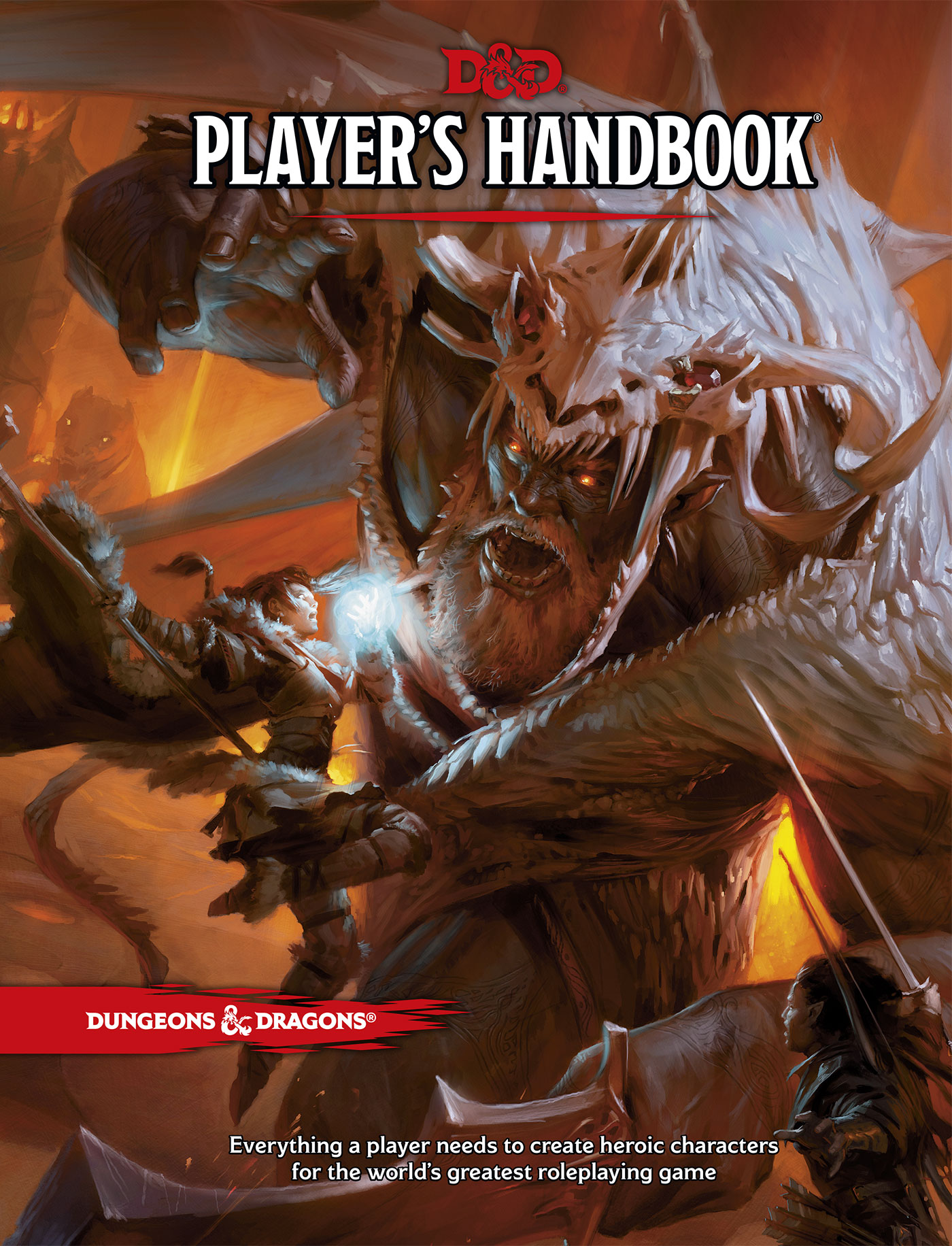
Dungeons & Dragons Fifth Edition Player's Handbook Review


Dungeons & Dragons 5th Edition Player’s Handbook Review

Come one, come all! Gather and hear! We have a review of the recently released Dungeons & Dragons Fifth Edition Player’s Handbook right here!

Since this game has been in existence for nearly a full decade prior to my birth, I do not even remotely claim to be an expert for two reasons; 1. where there are those whom have been playing since the game’s inception from TSR and the legendary late Gary Gygax first printings were released in 1974, and C. while I have played, I’ve not yet ever completed a single game. Ever since I was introduced to the game and the genre of tabletop RPG I have been enthralled. To my dismay, nary a single chronicle, campaign, or adventure have ever fully been seen through from beginning to end however. From lack-luster, disorganized and unimaginative (reads: boring) DM’s, to poorly timed IRL happenstance, for one reason or another I have still yet to play a full game of any tabletop RPG to completion. One can only hope that I may soon find some willing companions in the mood to guest for honor, treasure, and glory! But I digress...

Despite the lack of a full campaign and the wealth of XP that typically accompanies it under my belt, what I do know of D&D is that the current iterations of D&D are more re-tooling of Advanced Dungeons & Dragons that have been packaged and worked into such a manner that literally anyone can get a hold of the materials necessary for a campaign and dive right in after some familiarity. On the advent of 3rd edition, AD&D ceased to exist in a “new format” under its original name but continues on in a more widely approachable and accessible series. A few short years later, we received arguably the best set of comprehensive rules and resources with v3.5, which were then replaced by Fourth Edition in 2008. Most gamers and fans of the game abhor this edition as over-simplified and too stripped-down, so it’s no surprise that 4e is hailed by most as an utter failure. Now, six-years later we see the release of Fifth Edition (originally called D&D: NEXT while in-development) products hitting the shelves. A new format, with upgraded and shiny-new styling, plus an all-new story.
Just check out that ampersand! Ain't she a beaut?!

Of course, when I heard that Wizards was offering the Basic Rules for free via pdf from their website, I was on that download faster than a dragon to its treasure hoard just to see what we would be dealing with. Inside we find that three of the 110 pages are a blank character sheet, the rest are exactly what you would expect, the basic rules and information needed to get any D&D neophyte started in the game. Come to find out, week’s later they released the 5e Starter Kit; complete with everything you need to start a campaign including ready-made pre-generated characters, as well as the newly-designed blank character sheets, a 64-page booklet for the DM which includes a sample adventure ("The Lost Mine of Phandelver") and all the info you’d need to play in that adventure, a 32-page booklet for playing levels 1-5, and a shiny set of blue dice. The differences between the free pdf and the Starter Set are significant but here’s the catch; if you’re looking to get into D&D for the first time or are playing with new people who have no experience playing the game - and have decided to start with 5e - I’d recommend getting your hands on both for the amount of included info that’s especially geared toward beginners; contrarily if you are quite familiar with D&D already, just pass right by them and head onto the books. Which brings us right back to our topic at hand!

It comes of no surprise to my friends that I was quite eager to get my hands on this new tome in the hopes of creating a new game for us to at least try out, but while the ultimate plans have since been squashed I am still excited to at least receive the new books of fifth edition moving forward. I kind of event went all out at this release, in addition to the Player's Handbook I also picked up the Horde of the Dragon Queen (the first supplement to the Tyranny of Dragons storyline for 5e) as well as a set of Moleskine graph notebooks for mapping and not one, but TWO new sets of dice to celebrate. (I’ll dive deeper on RPG essentials in a later article.) I have to admit, I’m pretty impressed with some of the updates WOTC has done with this latest edition. They said “streamlined” ad nauseam in the press leading up to the release, and they meant it every time. With a whopping 25/300 pages devoted to the most important, hard-set rules, the rest of the Player's Handbook is geared toward getting an adventurer ready to play the game as it’s namesake intends; roleplaying. While roleplaying and getting into character really ultimately depends on how your group plays, building a solid backstory on your character in 5e is integral to how the game is played. Case in point, if you build a good backstory for your new character, the game rewards you for it; offering skill proficiencies, related equipment, and other bonuses right out of the gate.

In Soviet Dungeons, Dagrons Roleplay YOU!
Lastly, I want to touch on what's really brought me into the life of a card-carrying geek; the artwork. Imagination printed and bound for all to see and admire, the stuff of legends made just that much more tangible. Rangers and wizards, elves, dwarves, and men who battle skeletons, orcs and goblins, and of course, DRAGONS! Well, 5e does not disappoint. From the cover design, which is less of an archaic grimoire and almost more of a graphic novel in style, and two-toned both in high gloss and flat textured printing, to the interior illustrations provided by 60+ artists and ranging from small line and shade vignettes to full-page, full-color illustrations, the Player's Handbook and Horde of the Dragon Queen do not disappoint artistically. I am really looking forward to the future releases of the Fifth Edition, and hopefully getting some play in with the new ruleset! For those yet unaware, the remaining schedule for 5th Ed. releases are as follows, all are available for preorder from Barnes & Noble, amazon.com, or your Wizards Play Network supported LGS;
September 30 – Monster Manual, that’s TODAY?!?
October 21 – The Rise of Tiamat 
December 9 – Dungeon Master’s Guide (originally Nov. 18)
January 20, 2015 – Dungeon Master’s Screen (expected, originally Jan. 6 '15)

And I'll be here at NGP to review and share my opinions of each release with the masses! So come on back this Thursday, where I’ll have a break down and review of the 5e Monster Manual with how it stands up agains previous editions. Now, if you’ll excuse me, I hear the sound of dice rolling and weapons clashing in the distance!

=Opaque=

Tuesday, September 23, 2014

Review: The Art of The Boxtrolls by Philip Brotherton - Chronicle Books


Review: The Art of “The Boxtrolls” by Philip Brotherton - Chronicle Books

Here Be Monsters! Indeed!
(photo source: Amazon)

Here’s a brief little switch up for all you NGP fans! Recently released to bookstores by Chronicle Books, The Art of The Boxtrolls by Philip Brotherton. If you’re a fan of animation and its art like I am, I can’t recommend a book more. Having picked up the “Art of” books for both Coraline and ParaNorman when they released, I was beyond excited for this book to hit the shelf. Detailing much of the production of the latest stopmotion feature from animation powerhouse Laika, the book showcases insight into their world from concept to finished product. Also included are a preface from Laika CEO and animator Travis Knight, and a foreword by director Anthony Stacchi, who both offer a bit of their personal insight for the project before we finally dig in.

Eggs: our main character
(photo source: CinemaBlend)

Based on Alan Snow’s 2005 full-length illustrated children’s novel, Here Be Monsters!, The Art of… charts the nine-year slow-cooked production that would become The Boxtrolls. Following the prefaces, the introduction gives a brief background on the story and the design of the feature. Then, this book is broken into four parts to better dissect the production at large; “Roaming the Streets,’ a look at building and filming the city environment; “The World Below,” the underground sewer homeworld of the boxtrolls and everything within, from the environment to our title characters and protagonist; “Snatcher’s Realm,” everything on designing the antagonists and their wares; and finally, “Life at the Top” focuses on dressing the animation puppets from armature to cloth to hair, and also includes a brief look at the 3D printing process used to control the smoothness of the animation to reduce “jitter.”

From cover to cover, this book is filled with images from sketches and doodles to maquettes and photos of the final puppets and props used throughout the feature, and all ranging from those on the production staff to original illustrations from author Alan Snow. (Who even offered his own works to be used as art in the sets for the film!) The detail in the book alone only further builds excitement for what awaits the big screen. Check this one out as a primer to seeing the movie, or after to catch details of your favorite characters and scenes!

It must be almost time…
(photo source: cgmeetup.com)


The Boxtrolls opens in movie theatres nationwide on Friday, September, 26

Tuesday, September 2, 2014

Settle the Score - Ghostbusters by Elmer Bernstein


Hello, and welcome to my new recurring series! In “Settle the Score,” I’ll be listening to and reviewing movie scores of the past and present. But first, a little primer.


Unlike a Motion Picture Soundtrack, which are compilations of existing or newly produced songs “from or inspired by” a movie, Original Movie Scores are composed and performed by an orchestra to play along with a movie, adding dramatic, suspenseful, romantic, dangerous, scary, and much more effect for the viewer. In my opinion, without scores movies would be quite flat – just a bunch of people talking and maybe a random explosion or car chase out of nowhere. As a classically trained musician through primary and secondary schooling, music is a huge part of my appreciation of the numerous movies I was raised on – and that’s something I’ve taken into my professional life, as well as my art. This recurring series will not be for the laymen. Period. So we need to get on the same page before I can move on to the topic. That said, I have a bone to pick before we get started on our selection…

Let me set one thing straight. Basically, the general term “theme” is tossed around mindlessly and interchangeably for multiple individual parts of musical composition by people who either can’t or choose not to do a little digging to actually say exactly what they mean; they say “theme” when they actually mean “motif” or “title song.” (I’ll get to these EXTREME differences in just a second…) “Theme music” is actually defined as a piece written specifically for a radio or television program, game, or movie, played during the title sequence or intro and/or end credits. Now, with a definition like that you can see why the term is used as a general category, because it can be relatively easy to confuse this term by simply forgetting it’s primary aspect. When you hear the same notes from the theme at the beginning of your movie later on in the movie itself, that’s not the theme! Further, a “theme song” is theme music with lyrics; a “title song” is a theme song named for the title of the work (think James Bond); and a “signature song” is one or a few songs that a popular/well-established singer or band is most closely identified with or best-known for – which really isn’t related to movie scores at all! Got all of that so far? Then let’s get to my point so we can move on.

What the laymen music reviewer actually means when they say “theme” is often one of two different somewhat-related terms; motif and leitmotif. But what are they, and if they’re different, how? Well, a motif is a short musical idea, recurring figure, musical fragment or succession of notes; to give the best example, think the four-note figure from Beethoven’s 5th Symphony, or the ten-note “Curse” phrase often used in early horror and cartoons where the character is tiptoeing around in a haunted house. Now, a leitmotif is a short, constantly recurring music phrase associated with a particular person, place or idea (also related to musical terms idée fixe and motto-theme). Literally translated from German, this term means “leading motif,” but can be more accurately translated as “guiding motif” as its recurrence brings the listener as well as the music in the direction of intended flow by its repeated presence. Your best examples are as numerous as there are stars in the night sky! There are hundreds of leitmotifs throughout Howard Shore’s scores for The Lord of the Rings and The Hobbit trilogies - the easiest to identify here is the eight-note figure for The One Ring, or the “Empire March” every time Darth Vader appears on screen in the original Star Wars trilogy. Hopefully you’re with me on this now, so this concludes your music theory lesson for this week. My apologies for the mini-rant there, now on to what we are really here for!


Even after 30 years, "Bustin' makes me feel good!" 

Celebrating the 30th anniversary of the release of arguably one of THE greatest movies of all time, cinemas nationwide have re-released Ghostbusters in an updated high definition format for one week only, starting August 29, 2014! This movie is near and dear to many of us at NGP, so this is a perfect opportunity to showcase its brilliance, and focus on one of its lesser-celebrated aspects – Elmer Bernstein’s ethereal score.
Who you gonna call?

Bernstein’s score has a few motifs that run throughout that almost serialize what’s happening on screen. From the lighthearted first track of the score, “Ghostbusters Theme” that it's bits can be heard often throughout the score in various iterations, the triumphant yet 80’s-cheesy infomercial-esque “We Got One!” (which also features the three-bar phrase from “Ghostbusters Theme”), to 5-note medium fanfare used to showcase Gozer in the track “Cross Rip,” and the eerie warbles used for any ghosts or paranormal elements. Flowing into tracks like "Venkman" and "Dana's Theme" we hear strings and woodwinds playing light, airy phrases the likes of suites we've come to expect to be penned by Vivaldi, Stravinsky, and Holst. But there's something more to be heard in these tracks, something that gives the listener the feeling for something…spooky, but what is it?

I was interested to find out how Bernstein was able to create most of the droning and warbling, oscillating sounds in this score, and was surprised to find that it wasn’t created the way I anticipated! Sounding similar to a Theremin, (think original series Star Trek theme music) in which the player (a thereminist) controls oscillations by varying the position of their hands over vertical (frequency) and horizontal (amplitude) antennae simultaneously, Bernstein actually used a far-lesser known instrument, the Ondes Martenot. The original electronic musical instrument, the Ondes is sort of like a pre-electric keyboard-type mini-organ in which the musician can vary tones, sustains, and create eerie effects by pressing on pedals, moving sliders and pressing the large button on an on-board modulator, while sliding a strange metal ring over oscillation tubes; all of which alter not only tonal pitches but pitch frequencies and oscillations as well. It’s pretty cool, and a shame that "Ondests" don't see much use today’s modern computer controlled and mixed sound effects engines in music production.

Leon Theremin's instrument

Playing the Ondes Martenot

The score for Ghostbusters ranges from light-hearted and whimsical to eerie and foreboding in an instant and back again, much the same way as the movie does, and is just as entertaining by itself as the movie is on the silver screen. Elmer Bernstein truly knocked this one out and made a score just as memorable as the movie it was written for! I highly recommend adding this score to your immediate download queue as soon as you can.


I'll wrap this article up right there! Let me know how you like the score (whether it's your first listen or hundredth), or if you have a suggestion for a movie score I should review in the future  down in the comments below. Thanks for reading!

=Opaque=